
Wastewater Treatment

in the wood-based panel industry

SCHRADER Wastewater Treatment

In view of the increasing future competition for water and the growing need for resource-efficient use of freshwater, wastewater treatment is becoming increasingly important in the wood-based materials industry.

SCHRADER’s wastewater treatment plant represents the optimal ecological and economic solution for the increasingly stringent regulations worldwide (e.g. the Water Framework Directive). The system enables fully automated wastewater treatment, as the products generated in one process stage serve as input materials for another process stage, even if the individual processes are separated in time or space.

Mechanical Pre-Treatment

In mechanical pre-treatment, the wastewater is separated from solid components in order to protect the evaporation system from blockages and abrasion and to minimize fouling.

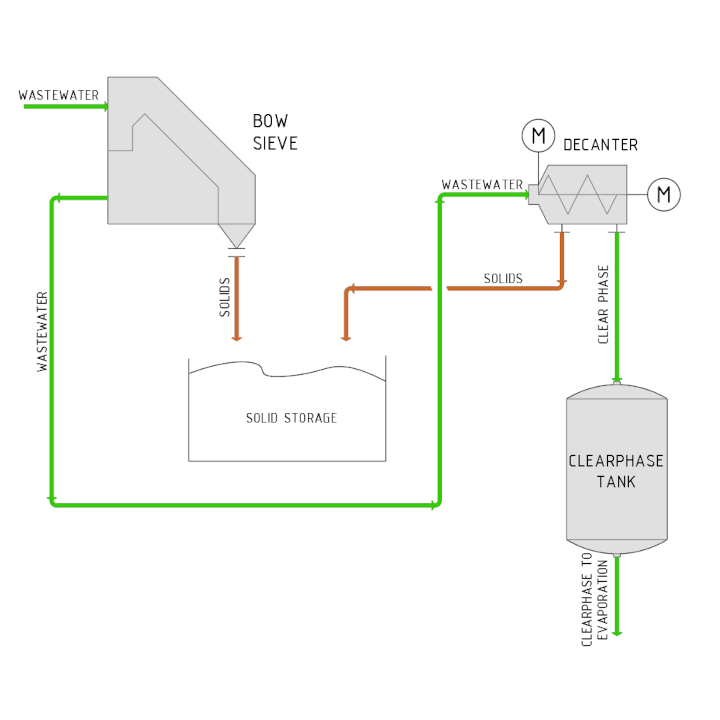
The mechanical pre-treatment consists of two cleaning stages connected in series: an arc screen for coarse particles and a decanter centrifuge for fine particles. The water from the wood is conveyed together with other production wastewater via the arc screen, where solids down to 0.5 mm are separated and fed to the solids storage. Optionally, the solids can be further dewatered before combustion.

The screened wastewater is collected in a tank used as a buffer and pumped from there to the decanter, where the remaining particles are separated by centrifugal force. The solids separated here are also fed to the solids storage, from which all filter residues can be thermally utilized in the energy plant with virtually no residue. The pre-treated wastewater is collected in the clear water tank and prepared for evaporation.

Mechanical Pre-Treatment: Separation of undissolved solids contained in the wastewater

  • Removal of coarse particles from process wastewater by means of an arc screen
  • Fine separation of remaining suspended solids by means of a decanter centrifuge
  • Feeding of the treated wastewater to evaporation
  • Solids for combustion

Evaporation

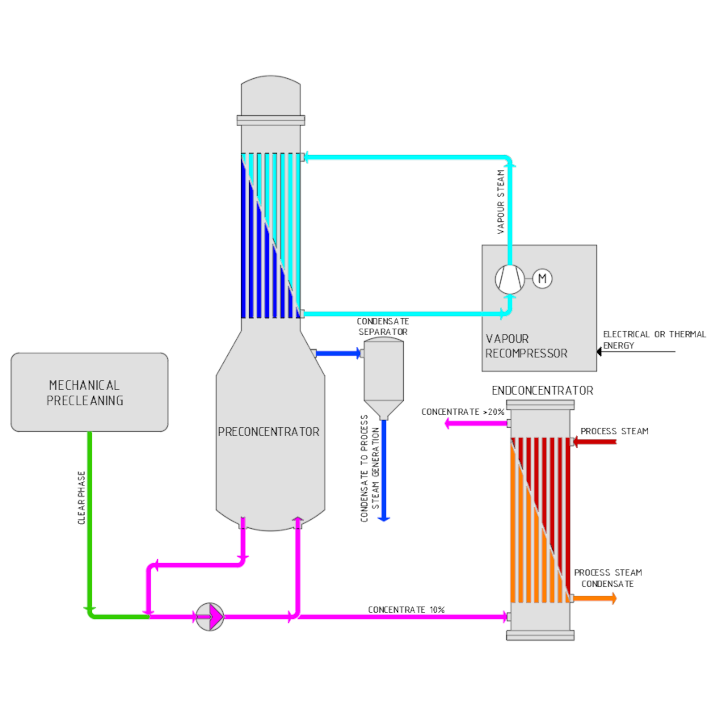
From the clear water tank, the wastewater loaded with dissolved substances flows into the two-stage falling film evaporator. Here, the dissolved substances are concentrated from 1–2 wt.% to approx. 10 wt.% and fed to the final concentrator.

For heating the falling film evaporator, the generated vapors are raised to a higher energy level in a vapor compressor; in addition, the vapor generated in the final concentrator heats the falling film evaporator. To utilize this energetically optimized mode of operation, continuous plant operation is required, as each start-up must be carried out with an increased supply of process steam.

In the final concentrator, which consists of a forced-circulation evaporator with an integrated shell-and-tube heat exchanger, the desired concentration of dissolved substances of 20–30 wt.% is achieved. This final concentrate is also fed to the energy plant for thermal utilization.

The vapor condensate generated in the falling film evaporator is reused in process steam generation. This ensures an almost residue-free treatment of production wastewater.

Evaporation of wastewater to provide condensate for process steam generation

  • Concentration of wastewater to 20–30 % dry matter
  • Use of vapor as a heating medium by mechanical or thermal vapor recompression (MVR)
  • Feeding of the concentrate to combustion

Process Steam Generation

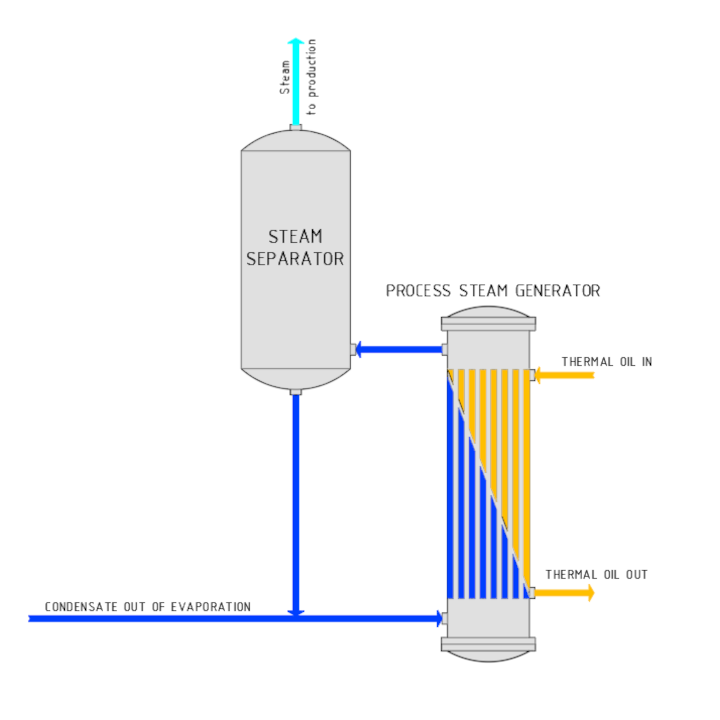
A steam generator operating according to the natural circulation principle is used to generate process steam and is heated with thermal oil or live steam. The steam generator consists of a vertically arranged shell-and-tube heat exchanger and a steam separator.

The collected vapor condensate from the evaporation system is used as feedwater; if additional demand arises, fresh water is supplied. The process steam is almost completely fed into the wood-based materials production plant. A small proportion of the process steam is used to heat the pre-concentrator and final concentrator of the evaporation system.

Process Steam Generation: Generation of process steam for feeding back into the process

  • Generation of process steam from the vapor condensate of the evaporation system
  • The process steam is reintegrated into the production cycle

SCHRADER Supervision

By using the latest data technology, it is possible to optimally support the operation of the technical plants with minimal effort. The data transparency thus created increases the diagnostic possibilities and has a positive effect on the operating efficiency of the system and the maintenance activities.

Contact

Our global network of experienced engineers is available to you by phone or e-mail. Don’t hesitate to get in touch.